0115 778 0622Engineers available now
Recent project

Landlord EICR at a Commercial Shop on Radford Road, NG7

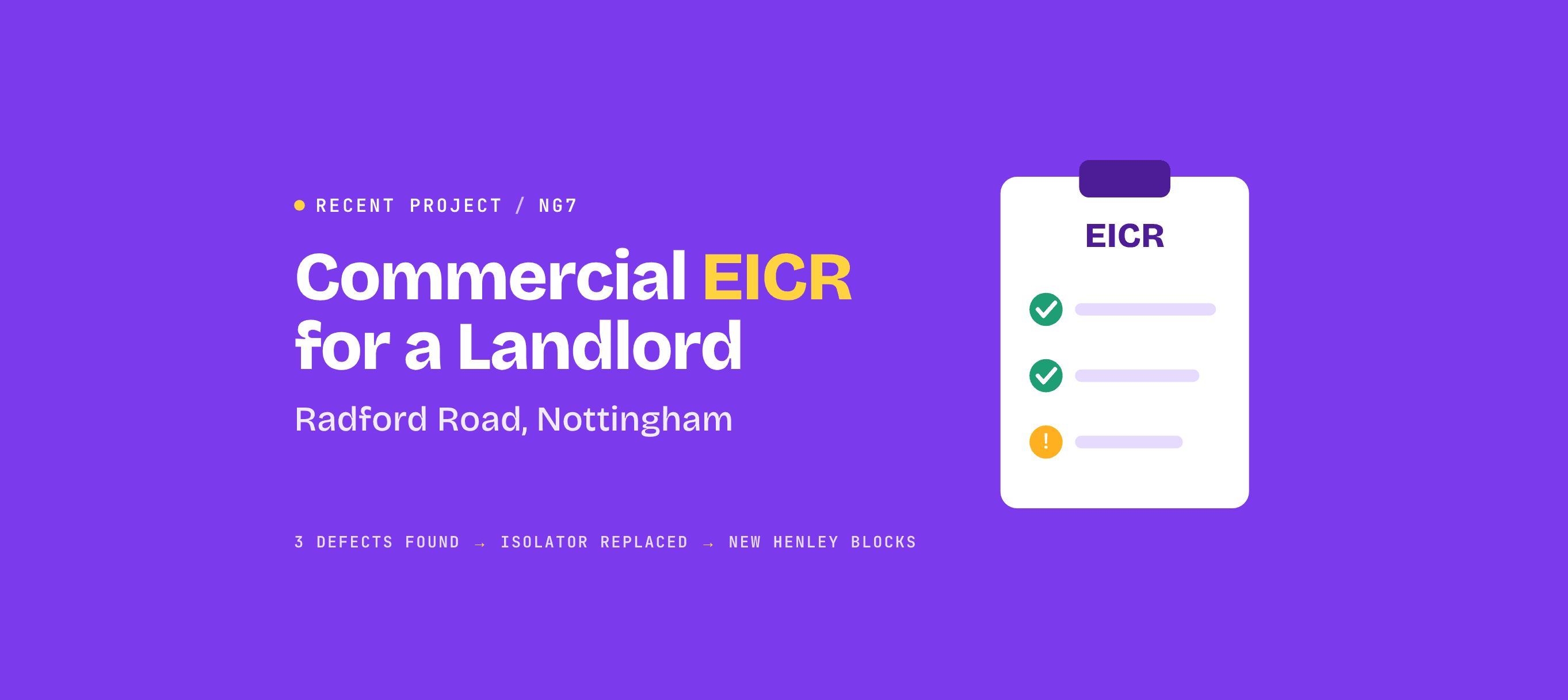
An EICR at an NG7 shop found three defects, with the broken main isolator and loose Henley blocks replaced.

Landlord EICR at a Commercial Shop on Radford Road, NG7
01

Overview

A quick summary of this project

A landlord asked us to carry out an Electrical Installation Condition Report (EICR) at a commercial shop on Radford Road, Nottingham, NG7. They planned to let the premises to a mobile phone repair business.

The consumer unit had already been upgraded to current BS 7671 requirements. The inspection found three defects. We replaced the broken main switch fused isolator, which had exposed live parts, and the unsupported Henley blocks. The main water bonding couldn’t be verified on the day.

02

The problem

What the customer's situation was before we got involved

The landlord was getting the shop ready for a new commercial tenant, a mobile phone repair business. Before letting the premises, they wanted to know the condition of the electrical installation, and an EICR is the standard way to find out.

A mobile repair shop relies on a steady supply for chargers, test equipment and soldering tools. Any hidden defects needed to be found and dealt with before the tenant moved in. The landlord needed a clear picture of what was safe, what needed attention and what couldn’t be checked.

03

What we did

The work carried out on this job

We carried out a full EICR on the shop’s electrical installation. An EICR inspects and tests the existing installation to identify any damage, deterioration, defects or conditions that could be dangerous.

The installation had a good starting point. The consumer unit had already been upgraded to meet BS 7671 requirements, so the main distribution equipment was in good order. The inspection did identify three defects elsewhere.

1. Broken main switch fused isolator. The fused isolator at the supply intake was broken, and live parts or cables could be touched. This was a serious safety concern, so we replaced the isolator.

2. Unsupported Henley blocks. The Henley blocks, which split the supply from the meter, were hanging loose instead of being securely fixed. We removed them and installed three new blocks, one each for the live, neutral and earth connections, mounted securely.

3. Main water bonding not verified. Main protective bonding to the incoming water pipe helps reduce the risk of electric shock if a fault occurs. We couldn’t verify it during the inspection because the landlord didn’t know where the mains water stop tap was. That meant the bonding connection point couldn’t be found and checked.

The two hazardous defects at the supply intake were put right, leaving the landlord with a clear record of the installation’s condition before the new tenant moves in.

05

Frequently asked questions

Common questions about this project