0115 778 0622Engineers available now
Recent project

Commercial Make-Safe for Building Strip-Out in the Lace Market

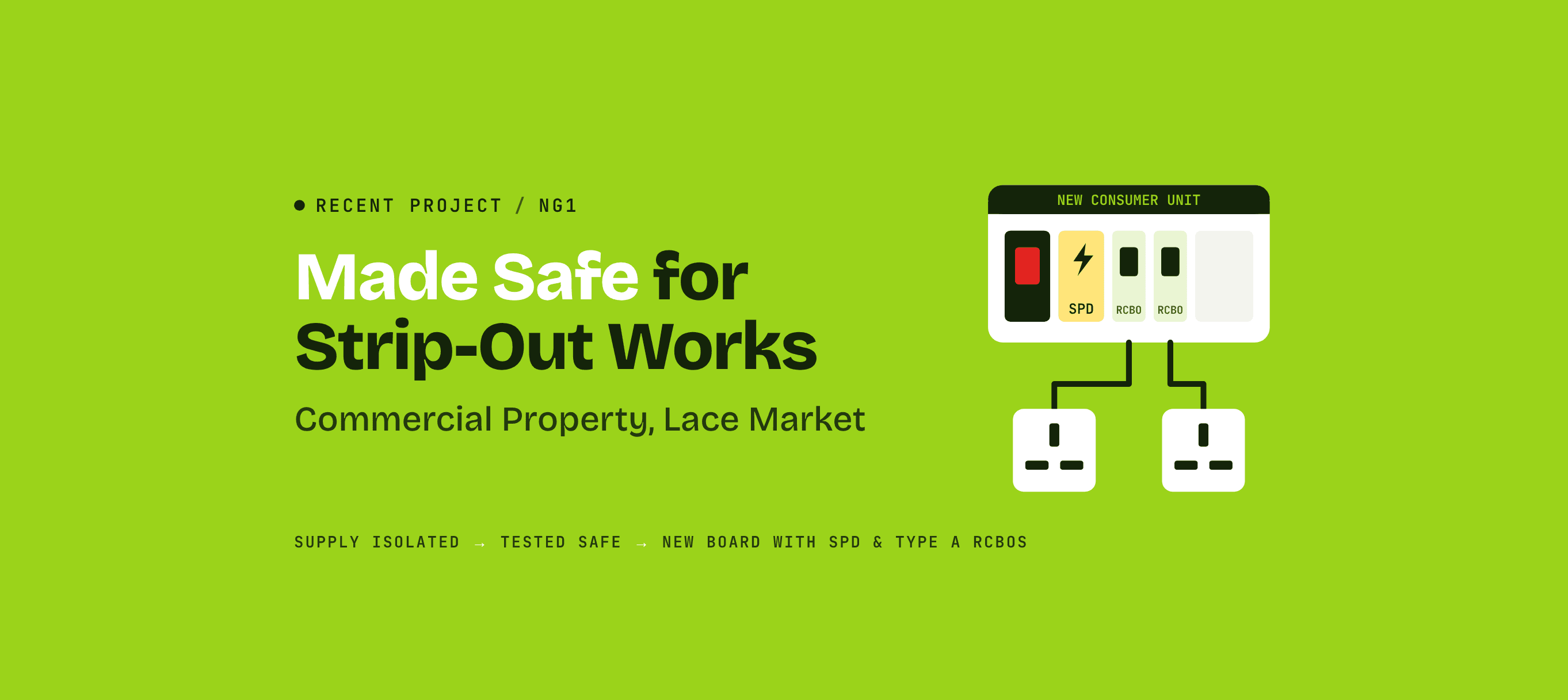
Lace Market property made safe for strip-out, with a new SPD consumer unit and two RCBO-protected sockets.

A newly bought commercial property in the Lace Market was made safe so strip-out work could begin.
01

Overview

A quick summary of this project

The new owner of a commercial property in the Lace Market, Nottingham, NG1, called us in before building work began. The building needed making electrically safe so it could be stripped out.

We isolated the existing electrics, tested to confirm the building was safe for strip-out, and installed a new consumer unit with surge protection. Two sockets, each protected by a Type A RCBO, now provide power for the building work.

02

The problem

What the customer's situation was before we got involved

The client had just bought the commercial property and planned to strip it out as part of the building works. Stripping out a building while the old electrics are still live is dangerous: walls, ceilings and fittings come out, and any live cable hidden in them puts workers at risk.

Before any strip-out could start, the electrical installation had to be made safe and confirmed dead where the work would happen. The contractors would still need power for tools and equipment, so the client also needed a safe, protected supply for the building work.

03

What we did

The work carried out on this job

We attended the commercial property in the Lace Market to make the electrics safe ahead of the building works.

The first priority was to isolate the existing installation so the parts of the building being stripped out were no longer live. We then tested to confirm the building was safe to strip out, so the contractors could remove walls, ceilings and fittings without the risk of hitting live cables.

To give the site a safe working supply, we installed a new consumer unit. It includes a surge protection device (SPD), which helps protect the installation and connected equipment from voltage spikes, such as those caused by lightning or switching on the supply network.

Power was then provided to two sockets for the building work. Each socket circuit is protected by its own Type A RCBO. An RCBO combines overload and short-circuit protection with residual current protection, so it switches off quickly if it detects earth leakage. Type A RCBOs also respond to certain types of DC fault current that can come from modern electronic equipment, such as power tools and chargers. Because each circuit has its own RCBO, a fault on one socket won’t take out the other.

The building is now safe to strip out, and the contractors have a protected supply to work from.

05

Frequently asked questions

Common questions about this project