Fire alarms only work if they're actually working — and a surprising number of systems fail during a real emergency simply because routine testing was skipped. Here's exactly how often your fire alarm should be tested, and who's responsible for each part of it.
How to Test a Fire Alarm
For a basic domestic smoke alarm, testing is straightforward: press and hold the test button until the alarm sounds, confirming the battery and circuitry are working. For commercial fire alarm systems, testing is more involved — it should be carried out by the building's designated "responsible person" for weekly call-point checks, with a full professional test carried out by a qualified engineer at set intervals.
How Often Should Fire Alarms Be Tested?
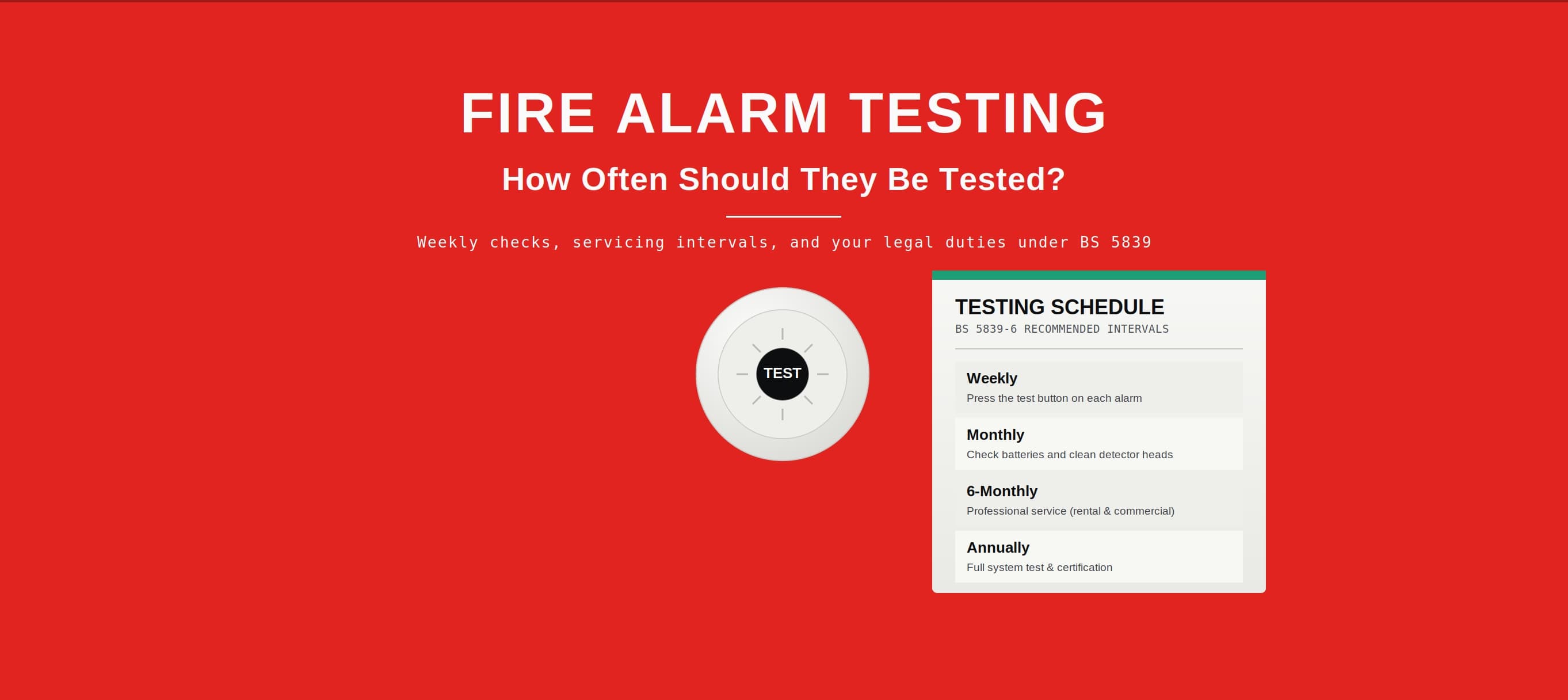
- Weekly — a different call point should be tested each week by the responsible person, on a rotating basis, to ensure the system can raise an alarm and signal to the control panel correctly
- Every 6 months — a full professional inspection and test, in line with BS 5839, covering detectors, sounders, backup power, and all call points
- Annually — for simpler domestic systems, an annual test is generally sufficient, though more frequent checks are recommended for higher-risk properties
Who Is Responsible for Fire Alarm Testing?
For commercial and rented properties, the "responsible person" (usually the employer, landlord, or building owner) has a legal duty under the Regulatory Reform (Fire Safety) Order 2005 to ensure fire alarm systems are maintained in efficient working order. This includes both the weekly in-house checks and arranging professional testing at the correct intervals.
What Happens During a Professional Fire Alarm Test?
Our fire alarm testing and maintenance service covers full inspection of the panel and all connected devices, functional testing of detectors and call points, battery and backup power checks, and testing of any interconnected systems such as door releases. Faults are documented clearly, with a fixed-price quote for any remedial work needed.
Do Landlords Need to Test Fire Alarms?
Yes — if you're a landlord, this sits alongside your other compliance obligations, including EICR inspections and PAT testing for rental properties. Many landlords choose to schedule all three together to simplify compliance management. If you manage an HMO specifically, testing requirements are often stricter — worth confirming your exact obligations.
What If My Fire Alarm Fails Its Test?
Any faults are documented and quoted separately as fixed-price remedial work, carried out by the same engineers who tested your system. This is different from a full new fire alarm installation, which covers fitting a system from scratch rather than testing an existing one.
FAQs
How often does a fire alarm need to be tested by law?
Weekly call-point testing by the responsible person, with a full professional inspection at least every 6 months for commercial systems under BS 5839.
Is fire alarm testing a legal requirement?
Yes, under the Regulatory Reform (Fire Safety) Order 2005, the responsible person for a business or rented property must ensure fire safety equipment is maintained and regularly tested.
Can I test my own fire alarm system, or do I need a professional?
Weekly call-point checks can be carried out in-house by the responsible person, but the full periodic test should be carried out by a qualified engineer to properly assess the whole system.
Will testing set off the alarm?
Yes, some tests require sounders and devices to briefly activate to confirm they're working — we agree timing with you in advance to minimise disruption.